
Renters on the Move: What We’re Seeing—and How Property Managers Can Adapt
If it feels like renter behavior has shifted over the past year, you’re not alone.
Across markets, property managers are seeing more early terminations, shorter notice periods before move-out, and an increase in abandonment situations.This shift isn’t about renters suddenly becoming irresponsible. It’s about people navigating a housing market that feels more expensive, more flexible, and more uncertain than it has in decades.
Affordability sits at the center of nearly every decision renters are making right now. Housing costs have risen faster than incomes, and many renters are operating with far less financial cushion. Even residents who can afford their homes may no longer feel confident they can do so comfortably long term. When financial pressure builds, people tend to look for exits—and they tend to make those decisions quickly.
Work-from-home has quietly changed the rules. When renters can technically live anywhere, they’re far more willing to move—and far less likely to overthink it. Once the decision to leave is made, the fact that there’s still time left on the lease often feels secondary.
New construction has added another layer. In markets where housing supply has increased—particularly in growing areas—renters now have more options than they’ve had in years. With more choice comes more movement. Where supply is limited, mobility slows. Where options expand, churn increases.
For property managers, these macro shifts don’t arrive neatly labeled. They show up as early termination requests, abrupt move-outs, communication drop-offs, and abandonment situations. It can feel reactive, but in reality, renters are responding to a system that feels volatile and, at times, unforgiving.
So how do property managers respond—especially when the trend doesn’t appear to be slowing down?
The first step is accepting that renter mobility is the new normal. The goal isn’t to prevent every move, but to manage movement intentionally.
At my company, Milestone Premier Properties, we’ve focused on creating systems that acknowledge renter mobility while protecting owner income and reducing disruption.
Our lease agreements include a clearly defined early termination clause that sets expectations from day one. Residents are required to provide written 30-day notice, pay an early termination fee equal to 80% of one month’s rent, and a re-leasing fee of 75% of one month’s rent. Once the resident vacates, we immediately begin marketing the property to line up the next renter.
In most cases, this approach results in little to no lapse in income for the owner—and in some situations, even a brief overlap. Residents who need to move have a clear, documented path forward. Owners benefit from predictability. And our team avoids the confusion and avoidance that often lead to abandonment.
Just as important as the clause itself is how it’s communicated. We don’t treat early termination as a penalty—we treat it as a process. Expectations are clearly explained upfront and reinforced along the way, so residents know exactly what to do if circumstances change.
But managing move-outs is only half the equation. The other half is keeping residents longer in the first place.
Retention today isn’t about locking renters into longer leases—it’s about reducing friction and increasing confidence. Renters are more likely to stay when they feel informed, supported, and confident in what to expect.
Clear communication plays a major role. Residents who understand renewal options early, know how rent adjustments are determined, and feel they can ask questions without pushback are far less likely to make reactive decisions.
Consistency also matters. Predictable maintenance response times, proactive follow-up, and clean, well-maintained homes create stability in an otherwise unstable environment. When renters trust that issues will be handled, they’re less inclined to shop alternatives.
Finally, flexibility—within structure—goes a long way. Transparent policies, reasonable renewal terms, and clearly outlined options help renters feel in control rather than trapped.
Renters may be on the move, but movement doesn’t have to mean disruption. Property managers who pair flexibility with structure, and clarity with communication, will be better positioned to navigate this new era of renter behavior.
As a property management professional still very much in the trenches, my best advice is simple: understand your residents and keep the lines of communication open.
When people know they can come to you, explain their situation, and feel heard, outcomes improve. From there, it’s about showing that care by clearly outlining their options.
Bottom line—treat people more human. Clear communication and thoughtful systems make all the difference.
 See you next time,
Brandy Landon
Broker/Owner
This week's must-sees
- PURE Property Management and HomeRiver Group announced a merger last week, bringing together two of the largest management companies in the country.
- Real Property Management has launched a new wealth optimization tool to support more strategic portfolio investment decisions.
New from Second Nature
Learn how you can create triple wins!
From credit building and time savings to vacancy reduction and more on-time payments, resident benefits can be a boon for residents, investors, and property managers. We ran the numbers, and the results are presented in our first ever Triple Win Impact Report.
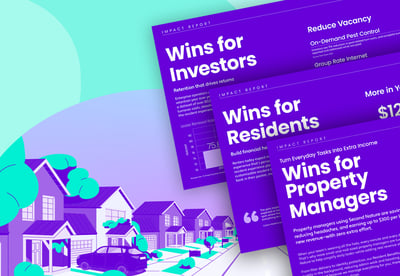
Not ready to download the full report? We outlined five key findings over on the blog!
Triple Win of the Week
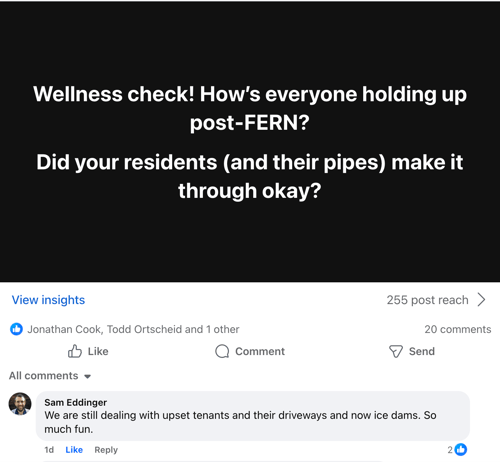
How did Fern impact your business?
Want to connect with other PMs to see how they're handling the winter weather? Join the conversation in our Triple Win Property Managers community!
Until next time,
💜 The Second Nature team
 August 26, 2026